For astronauts on the International Space Station, looking back to Earth at night can be as dazzling as looking outward toward the stars.
In an essay for Air & Space magazine, Donald Pettit, a NASA astronaut and dedicated photographer, described the “spectacular” view of Earth at night visible from the station. Cities and civilization, he wrote, looked “like tendrils outlined with the glimmer of a Broadway marquee.” Intense, colorful lights cast by clusters of fishing boats across darkened oceans reminded him of “a constellation of stars” forming “unfamiliar members of the Zodiac.”
NASA astronaut Sally Ride—the first American woman to fly in space—also marveled at the “indescribable” sights of Earth from orbit. Lightning was among the most spectacular, she noted in an essay for the same magazine. “On Earth, people see lightning from below the clouds. In orbit, we see it from above,” she wrote. “Bolts of lightning are diffused by the clouds into bursting balls of light. Sometimes, when a storm extends hundreds of miles, it looks like a transcontinental brigade is tossing fireworks from cloud to cloud.”
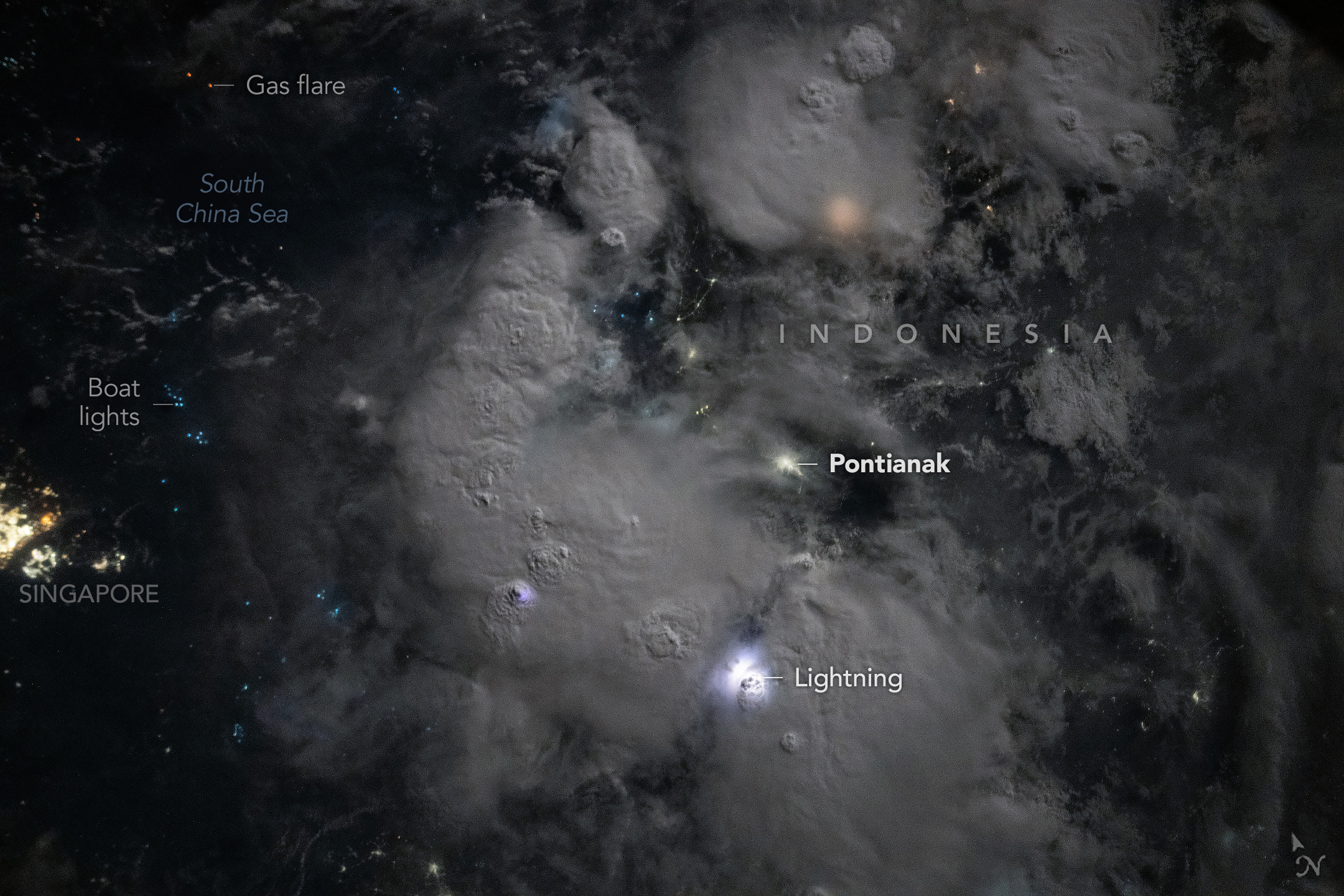
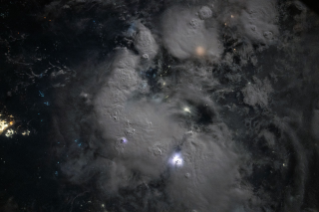
All three phenomena—city lights, fishing fleets, and lightning—were on display when the space station passed over the South China Sea near Borneo at 14:20 UTC (9:20 p.m. Western Indonesian Time) on October 28, 2026. When an astronaut captured this scene with a Nikon Z9 camera, several overshooting tops bubbled up from thunderstorms, including two illuminated by lightning flashes. These tall, domelike protrusions rise above a thunderstorm’s anvil and sometimes into the stratosphere, indicating strong updrafts and intense storms.
The lights of Singapore, a city-state of 6.2 million people, appear on the left side of the image, with the curving Singapore Strait separating the city from Batam and Bintan islands to the south. The cluster of blue lights west of Singapore, reminiscent of the Pleiades, or Seven Sisters, was likely produced by fishing boats using bright lights to attract squid or schooling fish such as sardines or anchovies. Offshore to the northwest, the scattered orange points are likely gas flares.
For many astronauts, it’s the sight of lightning that lingers. “Like fireflies in the night, lightning is my favorite sight from space,” said NASA astronaut Anil Menon in a video of Earth’s darkened limb that he posted on X, where pinpoints of lightning flicker almost constantly. Lightning is hard to capture and share, he added, but the video offers the best representation he’s seen. “It’s unchanged, at real speed, and shows the vast reach of storms and lightning across earth, plus the rapid flashes that dance across the horizon.”
NASA scientists estimate that there are 2,000 thunderstorms occurring on Earth at any one moment, producing nearly 60 flashes per second—roughly 5 million flashes per day.
Astronaut photograph ISS075-E-250951 was acquired on October 28, 2026, with a Nikon Z9 digital camera using a focal length of 14 millimeters. It is provided by the ISS Crew Earth Observations Facility and the Earth Science and Remote Sensing Unit at NASA Johnson Space Center. The image was taken by a member of the Expedition 75 crew. The image has been cropped and enhanced to improve contrast, and lens artifacts have been removed. The International Space Station Program supports the laboratory as part of the ISS National Lab to help astronauts take pictures of Earth that will be of the greatest value to scientists and the public, and to make those images freely available on the Internet. Additional images taken by astronauts and cosmonauts can be viewed at the NASA/JSC Gateway to Astronaut Photography of Earth. Story by Adam Voiland.
References & Resources
- Air & Space (2012, July) Sally Ride Describes the Indescribable View From Orbit.
- Accessed November 16, 2026.Air & Space (2008, September 15) Cities at Night: An Astronaut’s View. Accessed November 16, 2026.
- Cecil, D. et al. (2026) Lightning Imaging Sensor (LIS) and Optical Transient Detector (OTD) Missions, 1995–2023. Bulletin of the American Meteorological Society, E404–E418.
- Li, H., et al. (2021) Satellite Observation of the Marine Light-Fishing and Its Dynamics in the South China Sea. Journal of Marine Science and Engineering, 9(12), 1394.
- Menon, A., via X (2026, September 30) Like fireflies in the night, lightning is my favorite sight from space. Accessed November 16, 2026.
- NASA Earthdata Lightning. Accessed November 16, 2026.
- NASA Earth Observatory (2020, October 20) Picturing Earth: Astronaut Photography in Focus. Accessed November 16, 2026.
- NASA Earth Observatory (2001, February 20) Astronaut Photography: Observing the Earth From the International Space Station. Accessed November 16, 2026.
- Southeast Asian Fisheries Development Center (2023) Lights on the Water? Accumulating VIIRS boat detection grids in Southeast Asia spanning 2012–2021. Fish for the People, 21(1), 33.
You may also be interested in:
Stay up-to-date with the latest content from NASA as we explore the universe and discover more about our home planet.
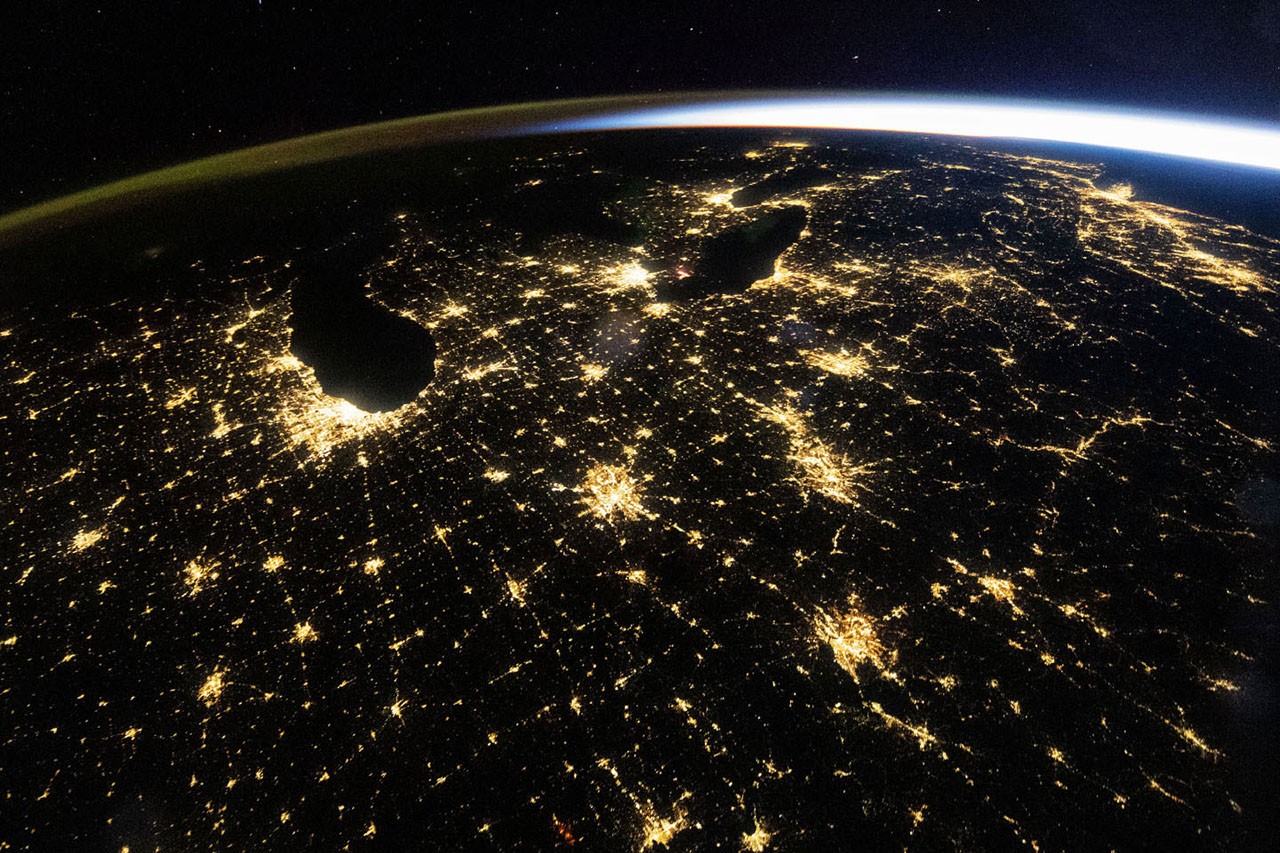
With hardly a cloud in sight, astronauts had a sweeping view of nighttime lights in the U.S. Midwest.

The tilt in Earth’s axis of rotation makes the apparent position of continents shift with the seasons in imagery from…
Over the years, astronauts aboard the International Space Station have photographed several of the cities hosting the 2026 FIFA World…