6 min read
Preparations for Next Moonwalk Simulations Underway (and Underwater)
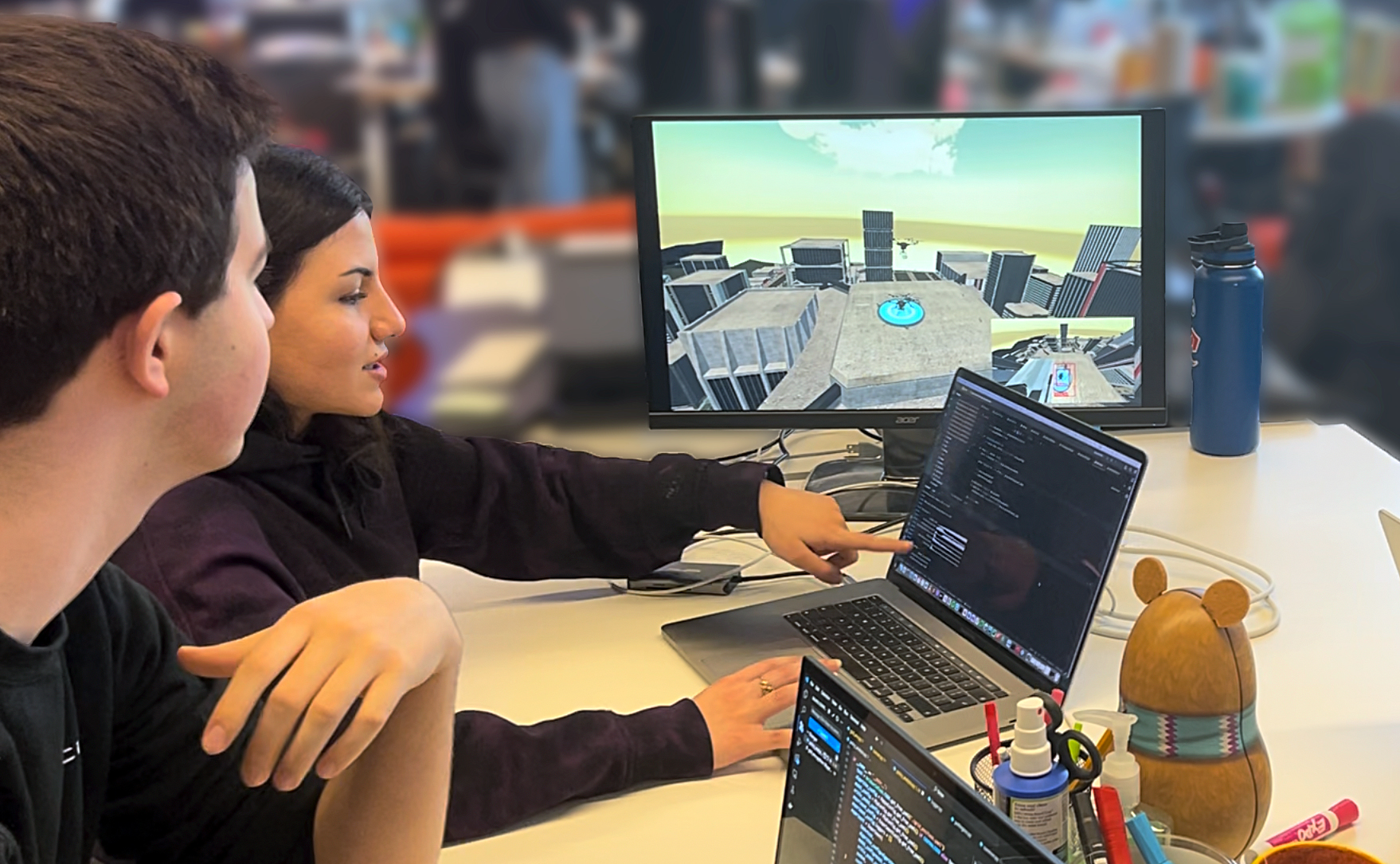
A team of Cornell University students are turning heads within industry and the federal government with the results of their research into creating a national air transportation management system in which thousands of drones could safely operate together.
NASA is sponsoring their work through the University Student Research Challenge (USRC), which provides grants to college students interested in helping the agency realize its aeronautical research goals.
“Looking at new traffic management systems for drones is not new,” said Mehrnaz Sabet, a doctoral student in the field of information science who serves as principal investigator on the grant and leads the Cornell team. “In fact, NASA has led that effort for years.”
Now, through USRC, NASA is giving Sabet and her team the chance to offer up innovative approaches to drone safety by managing their movements in the air, taking advantage of their young minds and fresh ideas.
The ultimate benefit of Cornell’s research in this area is the full realization of advanced air mobility, an area of industry focus that includes everything from urban flying taxis, more robust disaster response aircraft, and hot fresh pizza delivered right to your door.
The work also underscores the value NASA places on maturing cutting-edge technologies and helping to develop its future workforce through initiatives like USRC.
“Sabet and her team have demonstrated versatile skills involving software, algorithms, hardware, sensors development, laboratory tests, simulations, and actual flight tests – a rare combination,” said Parimal Koperdekar, acting director of NASA’s Airspace Operations and Safety Program.
Flying drones like we drive
Currently, drone operators must file plans that fully describes the intended flight path of the drone with a traffic management service. Those plans are checked with others to ensure there will be no collisions – what Sabet calls strategic deconfliction.
The challenge is that today’s air traffic management system is limited in its ability to handle the growing number of aircraft taking to the sky. Adding thousands of drones to the mix during the coming years risks over burdening the system, Sabet said.
What is needed in the air is essentially what we have on the ground – where millions of people drive on a road every day, she said.
As a driver you might know your whole “trajectory,” or the path you’d follow to reach your destination. But you would never coordinate your plan with every other driver on the road before you leave. Instead, traffic laws and infrastructure such as stop lights and traffic signs allow you to deconflict with other cars as you go.
Drone operators will still have to file flight plans saying where they intend to go, but the idea is to incorporate that car-like flexibility into drone operating systems, allowing them to be adaptable during their journeys.
“We need to ensure all these different types of drones can tactically deconflict with each other so that it is safe for them to operate like cars do on the ground. And that missing piece – tactical deconfliction – is at the center of our project,” Sabet said.
Two worlds joined
The key to the Cornell team’s research is the notion of integrating a simulated world with the real one to test and demonstrate how drones can learn to adapt to potentially hazardous conditions and make necessary corrections in their flight path on their own.
Knowing they could not go out and fly 100 drones at the same time to test their ideas for tactical deconfliction, the students decided to create an entirely virtual urban world to evaluate different high-volume traffic models, separation algorithms, and related data.
“Our first year of the project went into adapting and scaling that simulation engine and it all went very well,” Sabet said. “But we didn’t want to stick to a simulation. We wanted to see how the simulation translated to the real world, which mattered more.”
Still hampered by the limitations of how many drones they could operate and where they could fly – not many and basically in the middle of nowhere – they sought the best of both worlds, real and imagined.
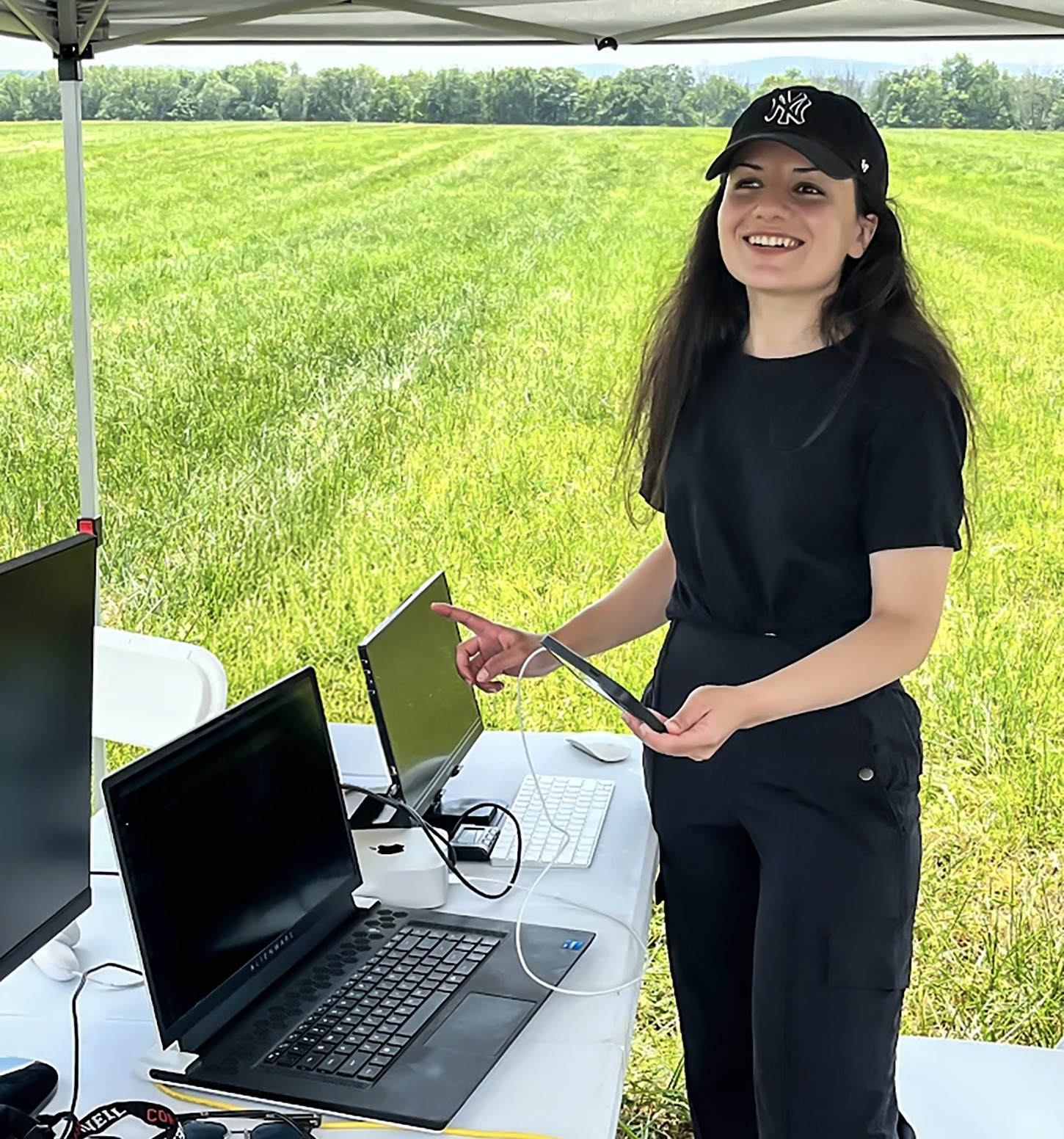
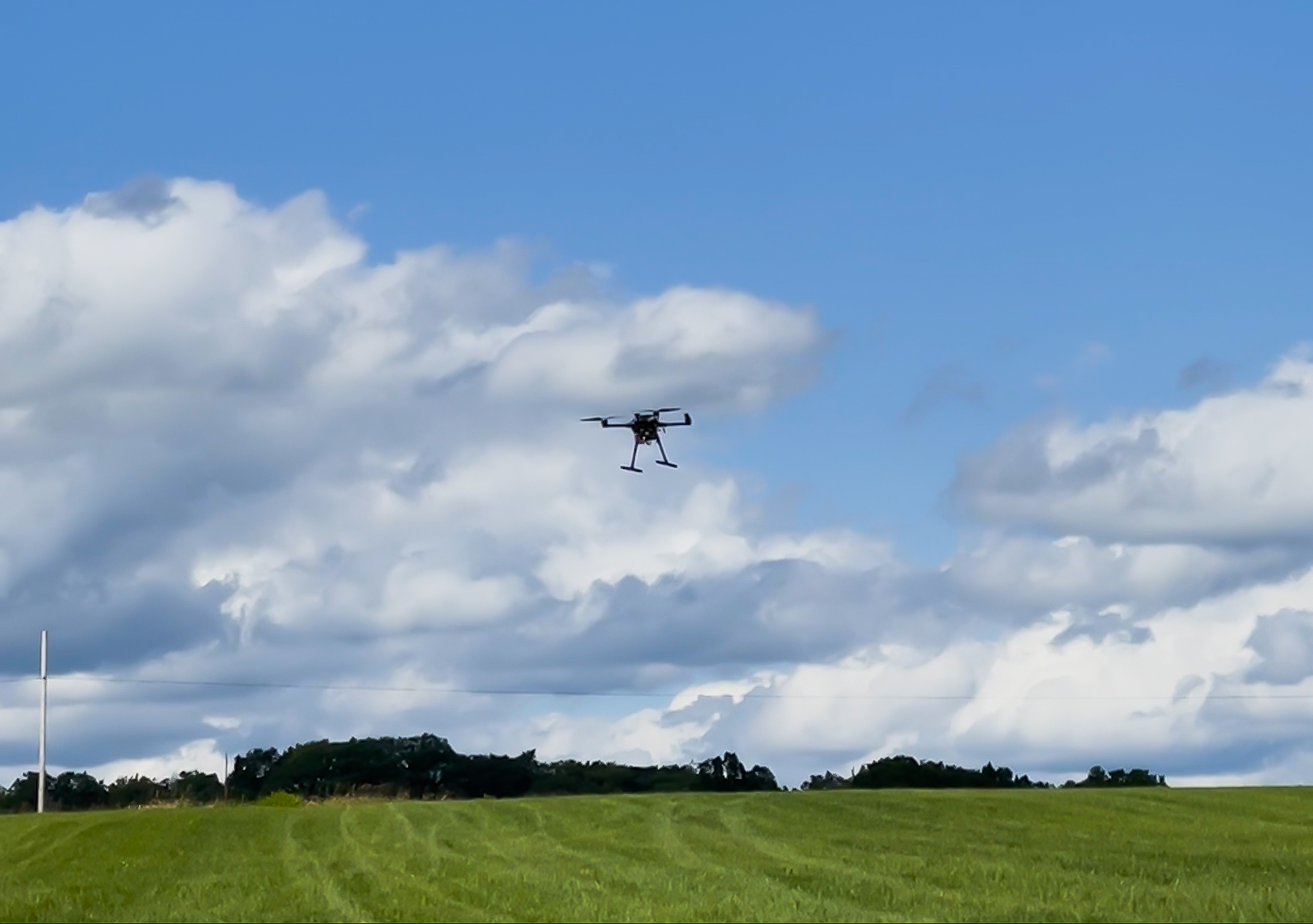
“What we wound up doing was to embed the simulation into a real drone, so the drone thought it was flying in a dense urban environment although it was actually flying out in an open field where there wasn’t a real city in sight,” Sabet said.
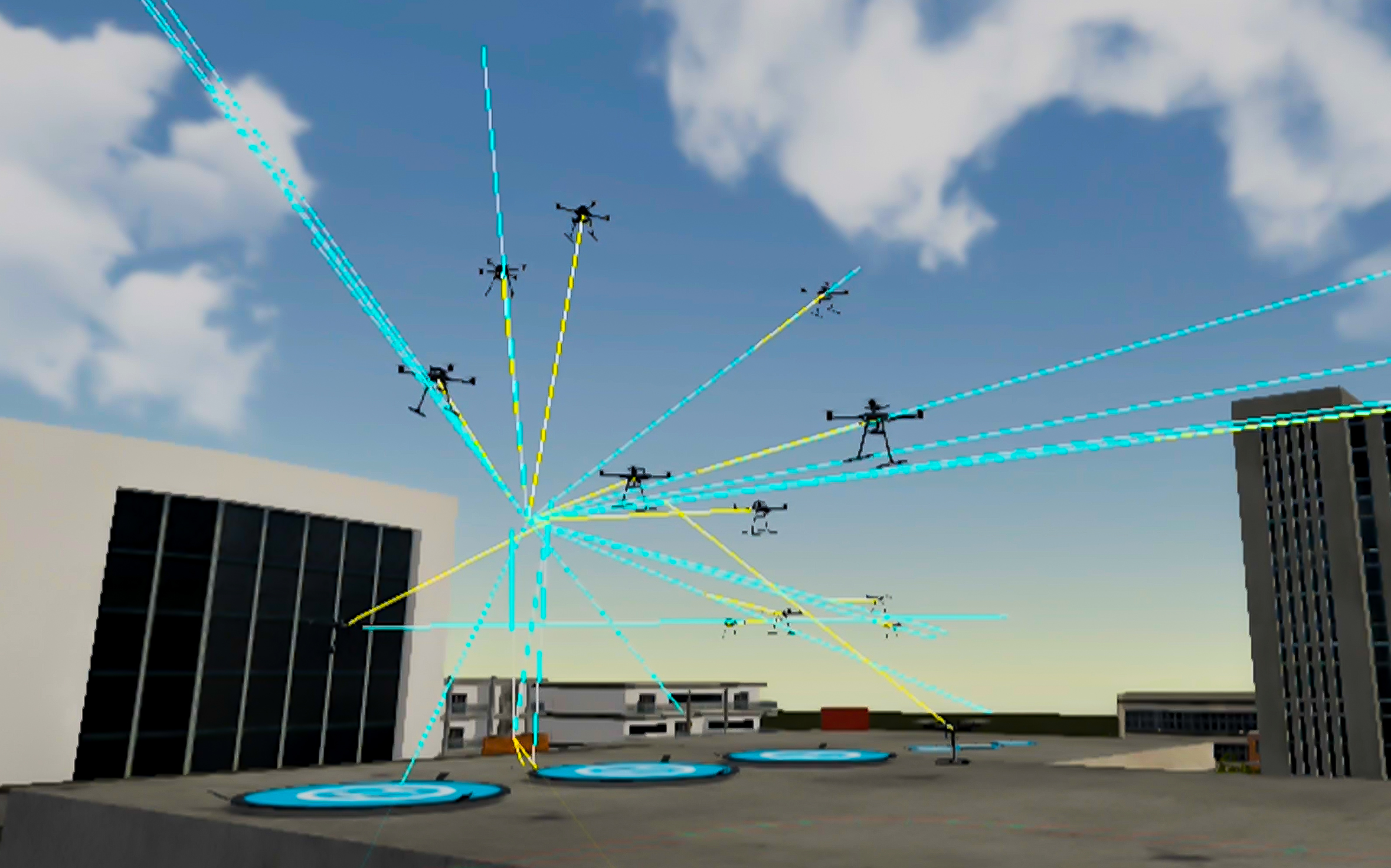
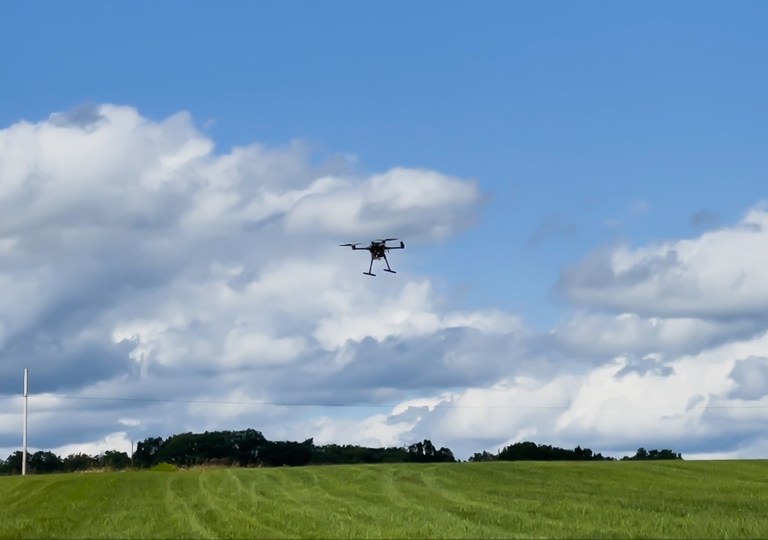
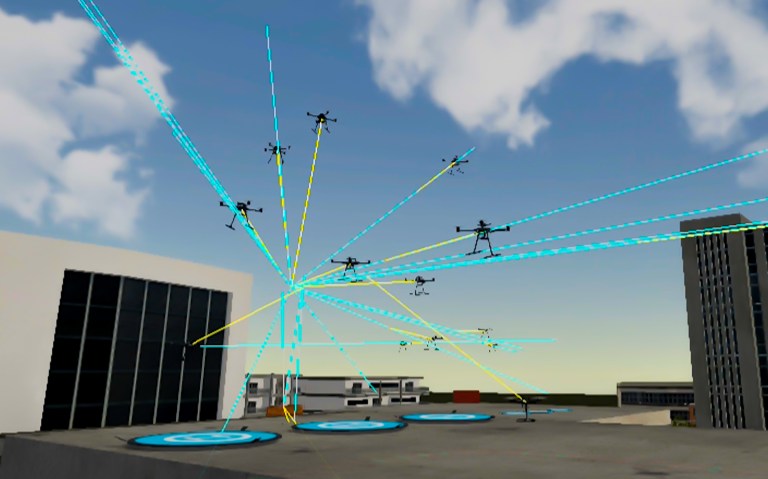
before
after
drone flight test
Combing real and simulated worlds
Real world lessons
This allowed the team to try out different traffic management tools and evaluate how drones might coordinate course corrections and avoid collisions with each other.
During the past year, they’ve taken the idea further by flying two real drones in the real world, each running the real-time simulation on board, allowing them to coordinate and “see” both simulated traffic and each other within the integrated test environment.
“We would then intentionally put them on a direct collision course to stress-test the detect and avoid and coordination models and see how well they react and coordinate the drone’s maneuvers to avoid hitting each other,” Sabet said.
Their success struck a chord with NASA experts in Unmanned Aircraft Systems Traffic Management (UTM).
“What’s impressive is that Cornell’s study included over 10,000 runs involving more than one million trajectories, and over 200,000 hours of experimentation to understand how multi-agent decentralized coordination would safely take place,” Kopardekar said.
Industry and the Federal Aviation Administration have also responded positively to this research and its potential. The team was asked to use its infrastructure and technology to virtually recreate an incident in 2025 in which a pair of drones collided with a stationary crane in Arizona. The team also showed how the accident could have been prevented.
The team was also asked to simulate recent, real-world fires in California to showcase how drones could better coordinate their movements both to provide situational awareness for public safety officials on the ground and to stay clear of fire-suppressing air tankers.
And according to the Cornell team, the FAA is interested in applying the project’s mix of virtual and real-world testing to evaluate drone operations under increasing levels of operational complexity.
“This kind of mixed-reality type of operational complexity enables them to test drone operations in a way that was not possible before,” Sabet said.
Thanks to NASA’s support through USRC, the Cornell team will continue to expand their capabilities and manage increasingly complex advanced air mobility operations.
“Our goal is to build the foundational systems that enable safe, large-scale autonomy in the skies,” Sabet said.
USRC is an opportunity within NASA’s Transformative Aeronautics Concepts Program under the agency’s Aeronautics Research Mission Directorate.
About the Author

Jim Banke
Jim Banke is a veteran aviation and aerospace communicator with more than 40 years of experience as a writer, producer, consultant, and project manager based at Cape Canaveral, Florida. He is part of NASA Aeronautics’ Strategic Communications Team and is Managing Editor for the Aeronautics topic on nasa.gov. In 2007 he was recognized with a Distinguished Public Service Medal, NASA’s highest honor for a non-government employee.