
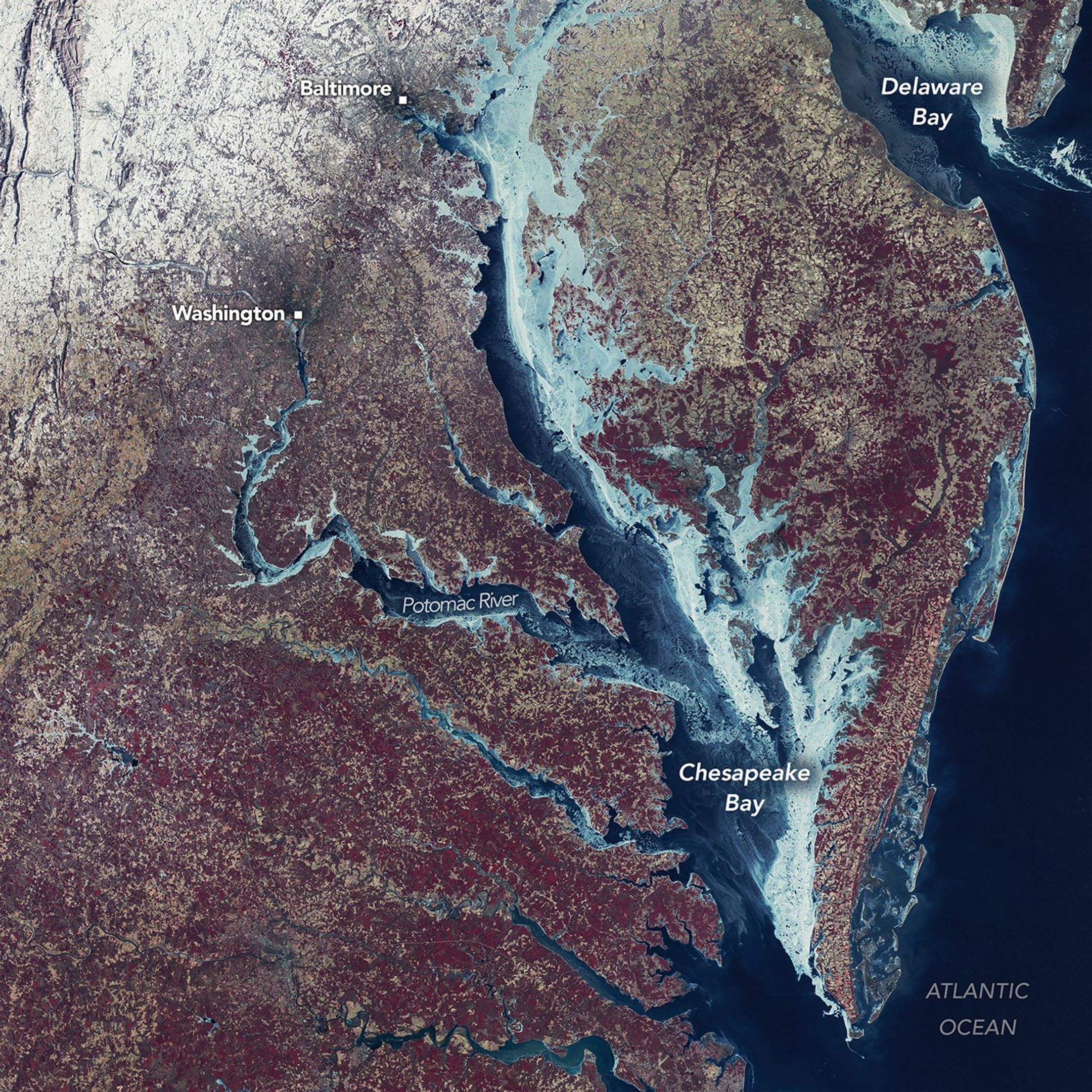
Residents of the U.S. Mid-Atlantic endured a formidable winter in 2025-2026, marked by several high-impact storms and prolonged stretches of cold temperatures that left parts of the Chesapeake Bay frozen over. Longtime residents may recall a winter nearly 50 years ago when the region saw even more widespread ice cover.
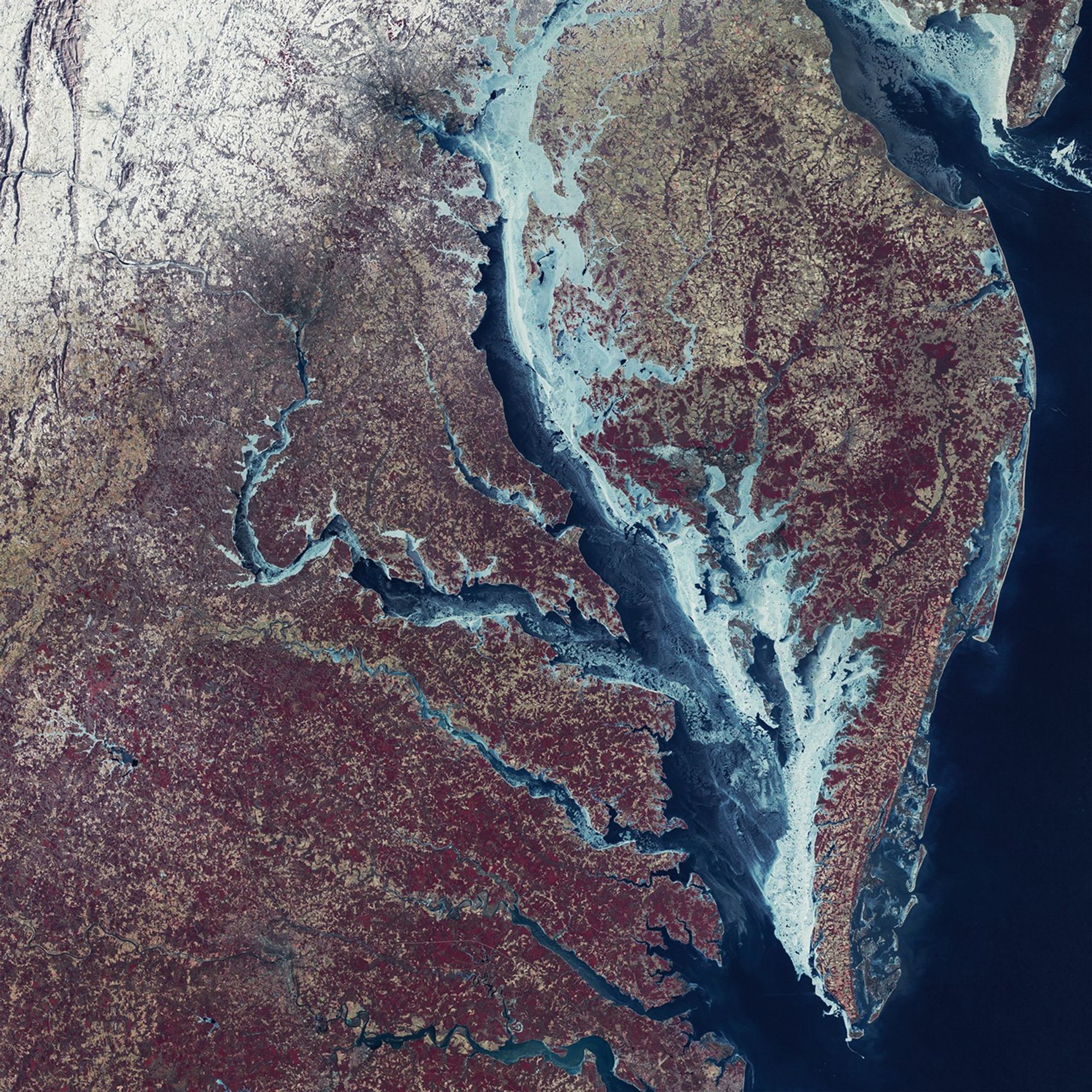
The MSS (Multispectral Scanner System) on Landsat 1 captured this image during the exceptionally cold winter of 1976-1977. The mosaic combines two Landsat scenes acquired on February 7 with a third captured on February 8. The landscape is shown in false color (MSS bands 6-5-4), in which ice appears in shades of blue, green, and white. On land, snow appears white, vegetation is red, and urban areas take on brown-gray tones.
A NASA analysis published in 1980 drew on these and other Landsat images to examine the anomalous ice conditions. Images indicate that ice began forming in the Chesapeake Bay’s upper tributaries in late December 1976 and spread to the middle of the upper bay by mid-January 1977. It reached its maximum extent around the time of this image, one week into February, when ice spanned 85 percent of the bay.
Persistent westerly winds at the start of February pushed ice toward the eastern shores of the Chesapeake and Delaware bays, contributing to fractures visible across the ice’s surface. As winds subsided, calmer conditions allowed new ice to form in areas of previously open water, visible in the image as thinner, darker blue patches. Reports from icebreaking operations indicated ice thicknesses reached up to 30 centimeters (12 inches) in the upper bay and up to 20 centimeters (8 inches) in the lower bay, with some tributaries seeing twice that amount.
Articles describing the event often show photos of people ice skating off Kent Island in front of the Bay Bridge and people driving cars and tractors across the ice. But the deep freeze strained the region, too. The ice and cold water caused high mortality in the area’s shellfish. And the crushing weight of the ice shifting with the tides damaged numerous piers, marinas, and lighthouses.
In winter 2025-2026, ice on the Chesapeake and Delaware bays appeared less extensive, with U.S. National Ice Center ice charts showing around 38 percent coverage on February 9 and 10. Still, concentrations in the upper bay and its tributaries this season were substantial enough to allow uncommon winter activities, including ice boaters racing across the frozen Claiborne Cove of Maryland’s Eastern Shore. At the same time, it created challenges for local watermen, according to news reports, trapping boats and limiting access to the bay.
NASA Earth Observatory image by Mike Taylor, Ginger Butcher, and Michala Garrison, using Landsat data from the U.S. Geological Survey. Story by Kathryn Hansen.
References & Resources
- CBS News (2026, February 9) Frozen Chesapeake Bay leaves Maryland watermen struggling during peak oyster season. Accessed February 26, 2026.
- Chesapeake Bay Magazine (2025, January 16) Ice Heroes: A Maryland Pilot’s Firsthand Account of the Historic 1977 Bay Freeze. Accessed February 26, 2026.
- Foster, J. L. (1980, March) Ice Conditions on the Chesapeake s Bay as Observes! from Landsat During the Winters of 1977, 1978 and 1979. NASA Technical Memorandum, 80657.
- Library of Congress (2023, July 28) The World as Seen by ERTS-1. Accessed February 26, 2026.
- NASA (2026, February 13) Landsat 1 Graphics Library. Accessed February 26, 2026.
- NASA (2026, February 12) Sick of freezing temperatures? For ice boaters, they’ve been a bonanza. Accessed February 26, 2026.
- Secrets of the Eastern Shore (2022, January 16) The Great Eastern Shore Deep Freeze of 1976-77! Accessed February 26, 2026.
- U.S. National Ice Center (2026, February 26) Mid-Atlantic Ice Chart. Accessed February 26, 2026.
You may also be interested in:
Stay up-to-date with the latest content from NASA as we explore the universe and discover more about our home planet.
A moderately intense season of surface melting left part of the ice sheet dirty gray in summer 2025, but snowfall…
Satellite data show that Arctic sea ice likely reached its annual minimum extent on September 10, 2025.

Sea ice around the southernmost continent hit one of its lowest seasonal highs since the start of the satellite record.