
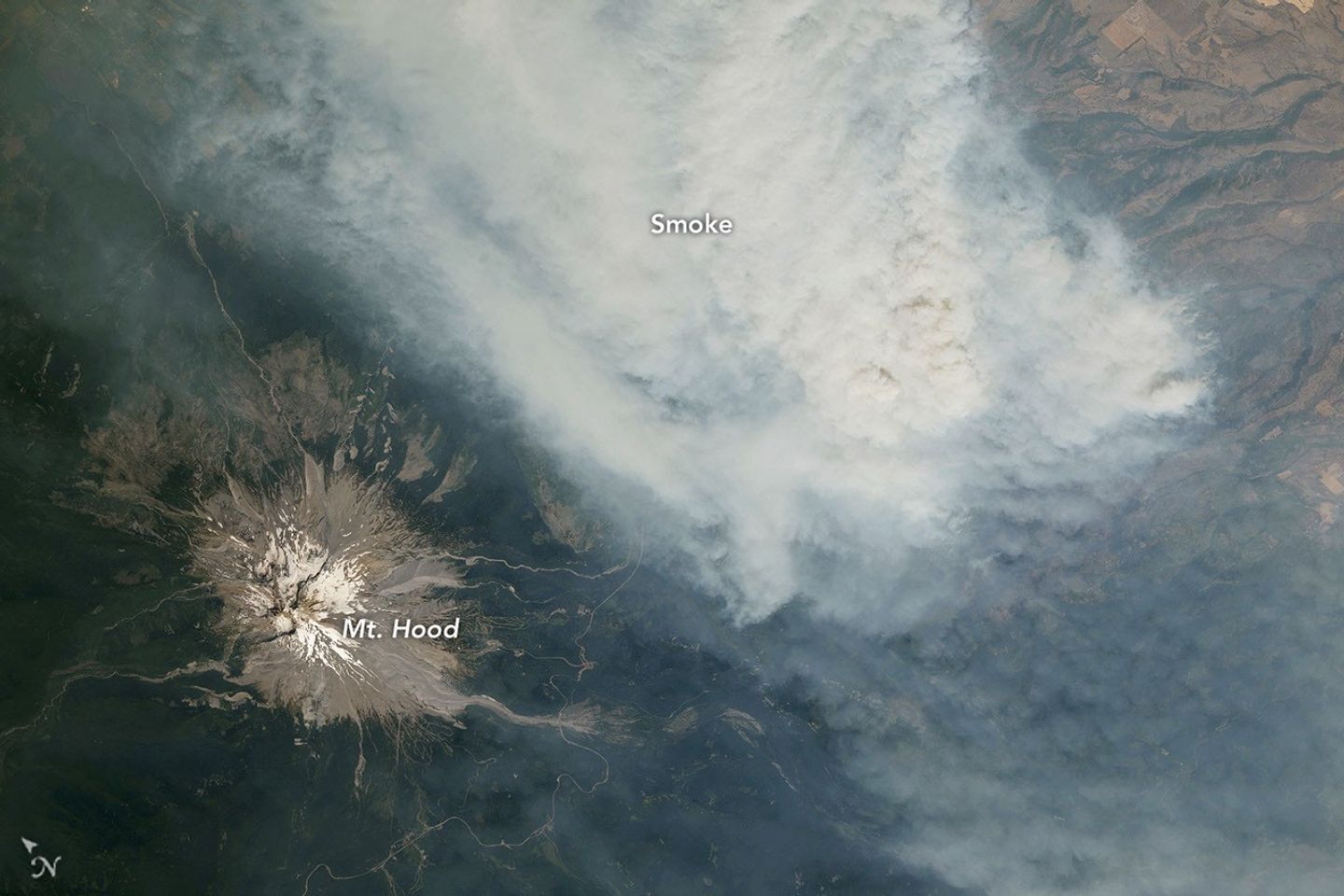
In a contrast of fire and ice, smoke from wildland fires mingled with several of the Cascade Range’s prominent, glaciated volcanoes in summer 2026. Astronauts on the International Space Station photographed the scene while orbiting over the U.S. West in late July and early August.
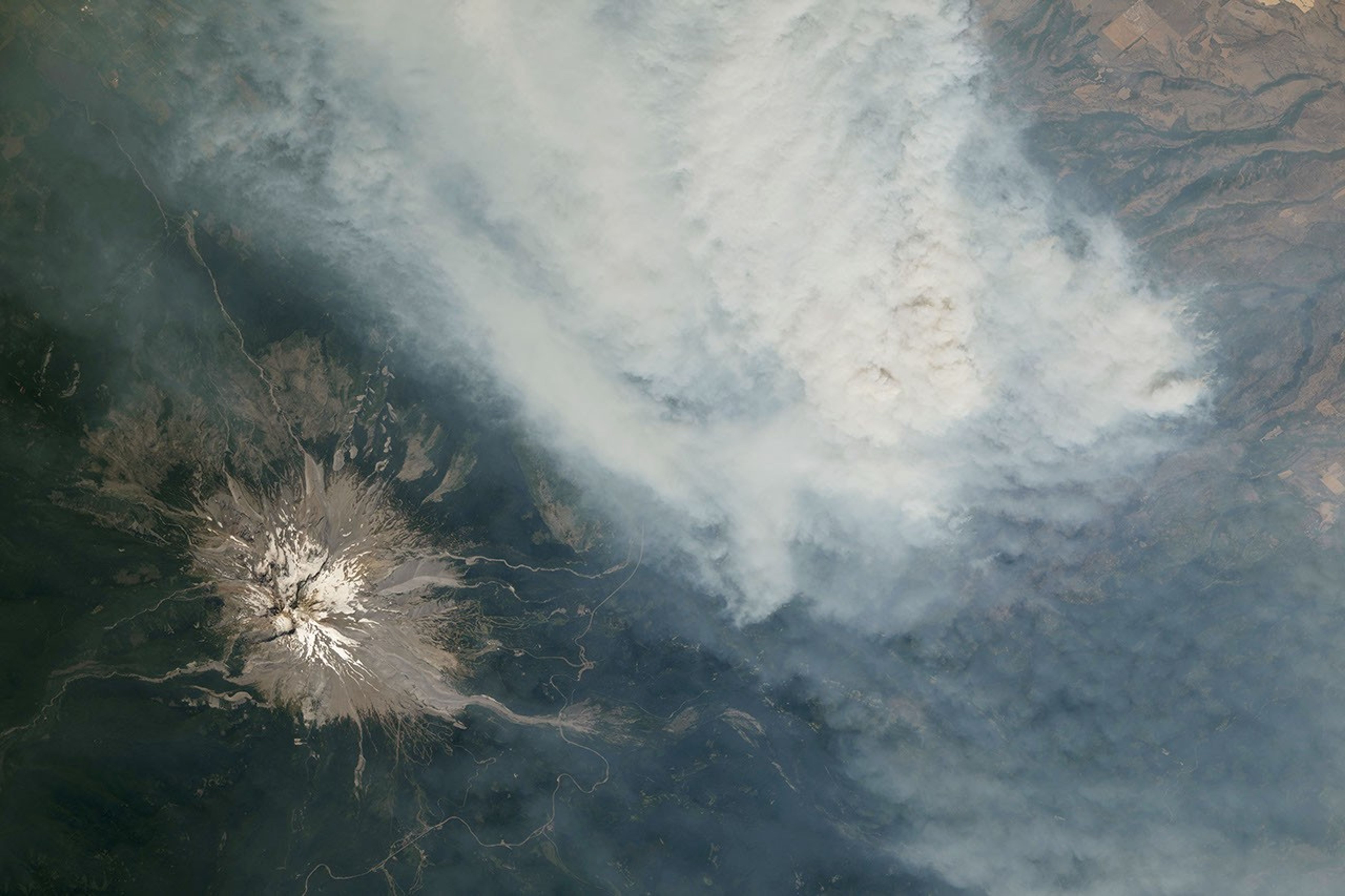
Mount Hood, Oregon’s tallest peak at 11,249 feet (3,429 meters), is pictured above, near a thick plume of smoke pouring from the Grasshopper fire. Thunderstorms passed over the forest in the preceding weeks, and a lightning strike on July 23 ignited the blaze pictured in this July 31 photo. The fire, burning east of the mountain, spread quickly north and east across Mount Hood National Forest amid hot, dry conditions, according to InciWeb.
As of August 12, it had burned nearly 84,000 acres (34,000 hectares) and spread beyond national forest boundaries. Several communities in Wasco County were under “go now” evacuation orders, and the nearby town of Dufur was advised to prepare for immediate evacuation.
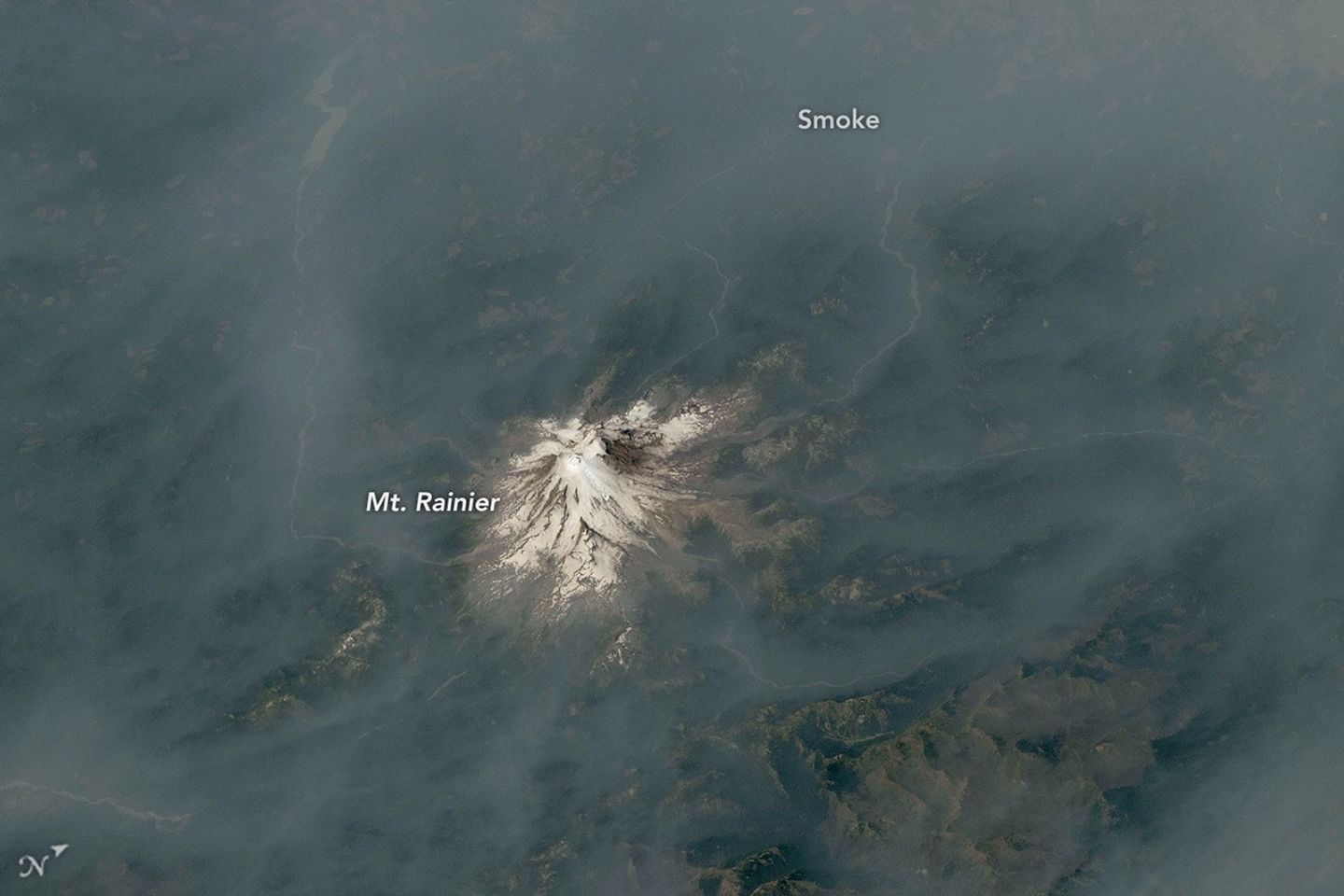
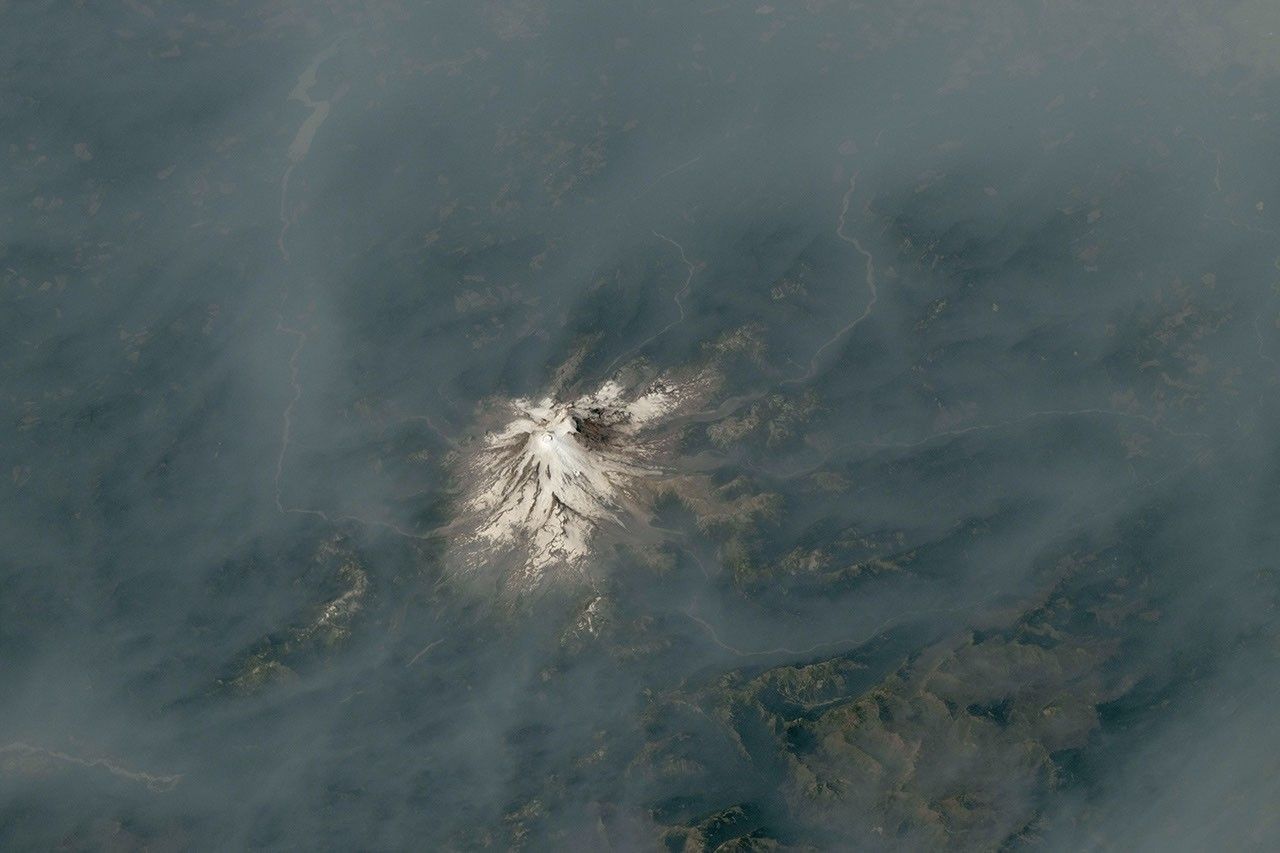
Roughly 100 miles to the north in Washington, Mount Rainier—the state’s tallest peak at 14,411 feet (4,392 meters)—was wreathed in smoke. No major fires burned nearby when this photo was taken on August 4. Instead, smoke drifted in from fires in central and eastern Washington, carried by winds blowing from the east due to a high-pressure system offshore. That day, the National Park Service reported that air quality in the park reached unhealthy levels due to elevated concentrations of fine particulate matter (PM2.5).
Several days later, the Grand Park 2 fire was observed burning within park boundaries, about 3 miles north of the Sunrise Visitor Center. As of August 12, the fire had burned 223 acres (90 hectares) and was uncontained; the cause was yet undetermined.
Above-normal fire potential was expected to persist across the Northwest through August, according to an outlook from the National Interagency Fire Center. Warm, dry weather—conditions influenced by El Niño—combined with cured fuels to set the stage for large, long-burning fires following lightning- or human-caused ignitions.
Astronaut photographs ISS075-E-1705 and ISS075-E-2221 were acquired on July 31, 2026, and August 4, 2026, respectively, with a Nikon Z9 digital camera using a focal length of 400 millimeters. They are provided by the ISS Crew Earth Observations Facility and the Earth Science and Remote Sensing Unit at NASA Johnson Space Center. The images were taken by a member of the Expedition 75 crew. The images have been cropped and enhanced to improve contrast, and lens artifacts have been removed. The International Space Station Program supports the laboratory as part of the ISS National Lab to help astronauts take pictures of Earth that will be of the greatest value to scientists and the public, and to make those images freely available on the Internet. Additional images taken by astronauts and cosmonauts can be viewed at the NASA/JSC Gateway to Astronaut Photography of Earth. Story by Kathryn Hansen.
References & Resources
- InciWeb (2026, August 12) Grand Park 2 Fire. Accessed August 12, 2026.
- InciWeb (2026, August 11) Grasshopper Fire. Accessed August 12, 2026.
- National Interagency Fire Center’s Predictive Services (2026, August 1) National Significant Wildland Fire Potential Outlook. Accessed August 12, 2026.
- OPB (2026, August 11) Fire growth near Mount Hood spurs fresh evacuations in Wasco, Clackamas counties. Accessed August 12, 2026.
- Washington Smoke Blog (2026, August 4) Smoke continues to build statewide, gradual improvement expected later this week. Accessed August 12, 2026.
You may also be interested in:
Stay up-to-date with the latest content from NASA as we explore the universe and discover more about our home planet.

Wildland fires in early August 2026 pushed air quality to unhealthy levels, destroyed hundreds of structures, and triggered mandatory evacuations…
The blaze burned more than 150 square miles and swept through parts of a ski resort.
Canadian wildfires sent plumes of smoke streaming over Ontario, Quebec, and parts of the U.S. Midwest and Northeast.