NASA’s Hubble Unexpectedly Catches Comet Breaking Up
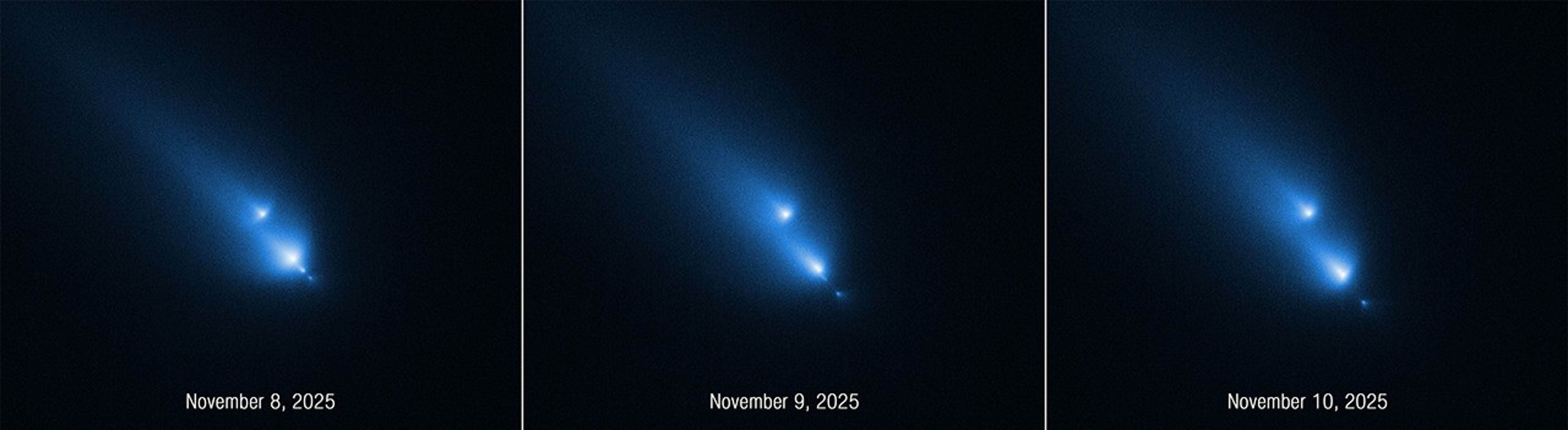
Image: NASA, ESA, Dennis Bodewits (AU); Image Processing: Joseph DePasquale (STScI)
In a happy twist of fate, NASA’s Hubble Space Telescope just witnessed a comet in the act of breaking apart. The chance of that happening while Hubble watched is extraordinarily minuscule. The findings published Wednesday in the journal Icarus.
The comet K1, whose full name is C/2025 K1 (ATLAS)—not to be confused with interstellar comet 3I/ATLAS—was not the original target of the Hubble study.
“Sometimes the best science happens by accident,” said co-investigator John Noonan, a research professor in the Department of Physics at Auburn University in Alabama. “This comet got observed because our original comet was not viewable due to some new technical constraints after we won our proposal. We had to find a new target—and right when we observed it, it happened to break apart, which is the slimmest of slim chances.”
Noonan didn’t know K1 was fragmenting until he viewed the images the day after Hubble took them. “While I was taking an initial look at the data, I saw that there were four comets in those images when we only proposed to look at one,” said Noonan. “So we knew this was something really, really special.”
This is an experiment the researchers always wanted to do with Hubble. They had proposed many Hubble observations to catch a comet breaking up. Unfortunately, these are very difficult to schedule, and they were never successful.
“The irony is now we’re just studying a regular comet and it crumbles in front of our eyes,” said principal investigator Dennis Bodewits, also a professor in Auburn University’s Department of Physics.
“Comets are leftovers of the era of solar system formation, so they’re made of ‘old stuff’—the primordial materials that made our solar system,” said Bodewits. “But they are not pristine—they’ve been heated; they’ve been irradiated by the Sun and by cosmic rays. So, when looking at a comet’s composition, the question we always have is, ‘Is this a primitive property or is this due to evolution?’ By cracking open a comet, you can see the ancient material that has not been processed.”
Hubble caught K1 fragmenting into at least four pieces, each with a distinct coma, the fuzzy envelope of gas and dust that surrounds a comet’s icy nucleus. Hubble cleanly resolved the fragments, but to ground-based telescopes, at the time they only appeared as barely distinguishable, bright blobs.
Hubble’s images were taken just a month after K1’s closest approach to the Sun, called perihelion. The comet’s perihelion was inside Mercury’s orbit, about one-third the distance of the Earth from the Sun. During perihelion, a comet experiences its most intense heating and maximum stress. Just past perihelion is when some long-period comets like K1 tend to fall apart.

Before it fragmented, K1 was likely a bit larger than an average comet, probably around 5 miles across. The team estimates the comet began to disintegrate eight days before Hubble viewed it. Hubble took three 20-second images, one on each day from Nov. 8 through Nov. 10, 2025. As it watched the comet, one of K1’s smaller pieces also broke up.
Because Hubble’s sharp vision can distinguish extremely fine details, the team could trace the history of the fragments back to when they were one piece. That allowed them to reconstruct the timeline. But in doing so, they uncovered a mystery: Why was there a delay between when the comet broke up and when bright outbursts were seen from the ground? When the comet fragmented and exposed fresh ice, why didn’t it brighten almost instantaneously?
The team has some theories. Most of a comet’s brightness is sunlight reflected off of dust grains. But when a comet cracks open, it reveals pure ice. Maybe a layer of dry dust needs to form over the pure ice and then blow off. Or maybe heat needs to get below the surface, build up pressure, and then eject an expanding shell of dust.
“Never before has Hubble caught a fragmenting comet this close to when it actually fell apart. Most of the time, it’s a few weeks to a month later. And in this case, we were able to see it just days after,” said Noonan. “This is telling us something very important about the physics of what’s happening at the comet’s surface. We may be seeing the timescale it takes to form a substantial dust layer that can then be ejected by the gas.”
The research team is looking forward to finishing the analysis of the gases to come from the comet. Already, ground-based analysis shows that K1 is chemically very strange—it is significantly depleted in carbon, compared with other comets. Spectroscopic analysis from Hubble’s STIS (Space Telescope Imaging Spectrograph) and COS (Cosmic Origins Spectrograph) instruments is likely to reveal much more about the composition of K1 and the very origins of our solar system, as NASA’s space telescopes continue to contribute to our understanding of planetary science.
The comet K1 is now a collection of fragments about 250 million miles from Earth. Located in the constellation Pisces, it is heading out of the solar system, not likely to ever return.
The Hubble Space Telescope has been operating for over three decades and continues to make ground-breaking discoveries that shape our fundamental understanding of the universe. Hubble is a project of international cooperation between NASA and ESA (European Space Agency). NASA’s Goddard Space Flight Center in Greenbelt, Maryland, manages the telescope and mission operations. Lockheed Martin Space, based in Denver, also supports mission operations at Goddard. The Space Telescope Science Institute in Baltimore, which is operated by the Association of Universities for Research in Astronomy, conducts Hubble science operations for NASA.
Related Images & Videos
Fragmentation of Comet C/2025 K1
This series of images from NASA’s Hubble Space Telescope of the fragmenting comet C/2025 K1 (ATLAS) was taken over the course of three consecutive days: Nov. 8, 9, and 10, 2025. This is the first time Hubble has witnessed a comet so early in the process of breaking up.
Comet C/2025 K1 Orbit Illustration
This diagram shows the path Comet C/2025 K1 (ATLAS), or K1, took as it swung past the Sun and began its journey out of the solar system. NASA’s Hubble Space Telescope captured the inset image of the fragmenting comet just a month after K1’s closest approach to the Sun.


Share
Details
Claire Andreoli
NASA’s Goddard Space Flight Center
Greenbelt, Maryland
claire.andreoli@nasa.gov
Ann Jenkins, Christine Pulliam
Space Telescope Science Institute
Baltimore, Maryland